
How it's made
Every model is made to order, one at a time, in Yaletown, Vancouver. Here's what happens between your click and your wall.
-
You pick the place
You choose the square on the map and see it in 3D. When you order, we save the exact map data from that moment, so later map edits don't change your model. If something in the preview looks off, reply to your receipt: we check before printing.
-
The map becomes print files
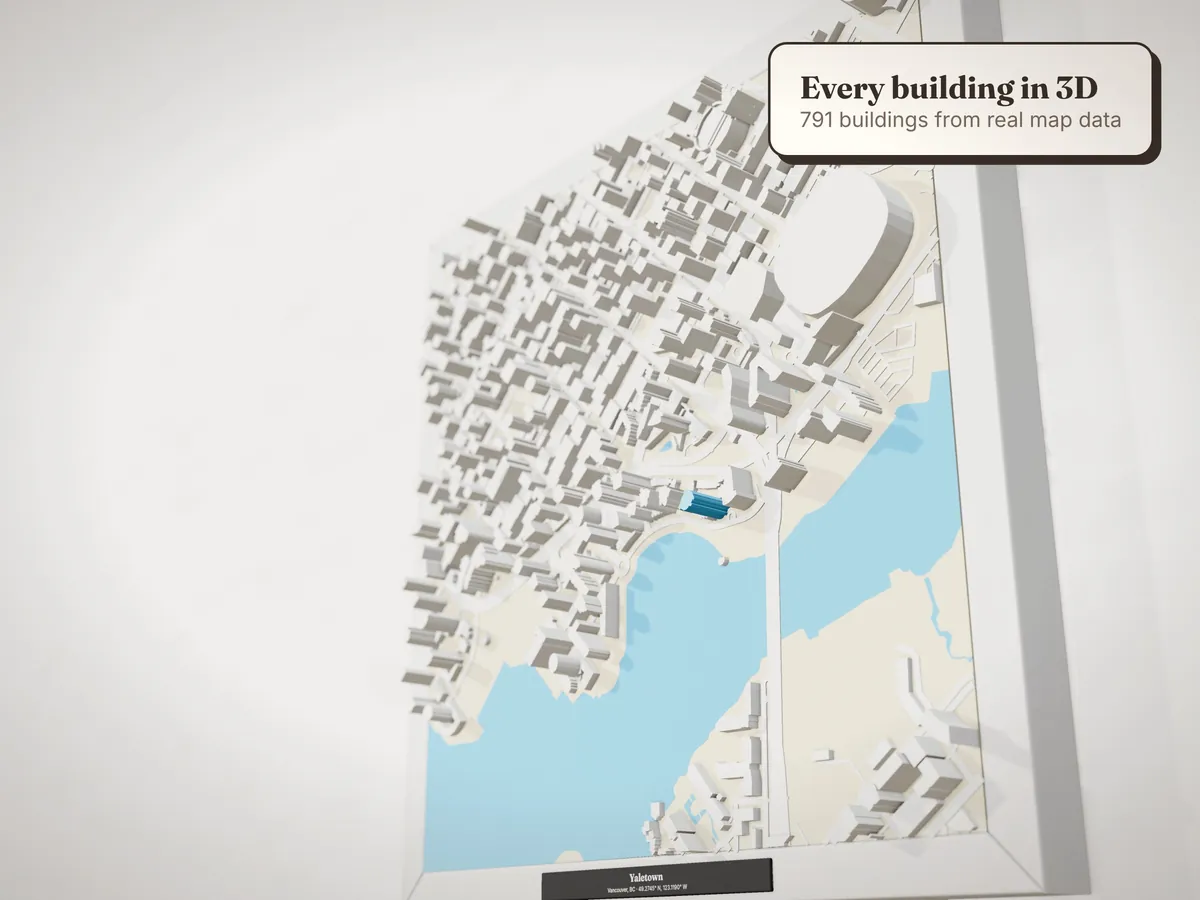
Buildings, streets, water and parks come from OpenStreetMap, the map made by volunteers around the world. Software turns your square into a 3D model at 1:5,500. Buildings are made 1.5× taller than true scale so a house reads as a house, not a speck. Above about 9 storeys, towers ease in gently so they don't dwarf everything else. The base prints flat unless the ground really rises: where it climbs 15 m or more inside the frame, the hills print in steps like a relief map, each step a contour line, so you can see how the streets climb.
Water sits just below the land, so shorelines catch the light. Parks, gardens and woods print in green with small pointed trees, the same trees you see in the preview, and bridges stand on piers with a gap over the water.
-
It's printed in layers thinner than a business card
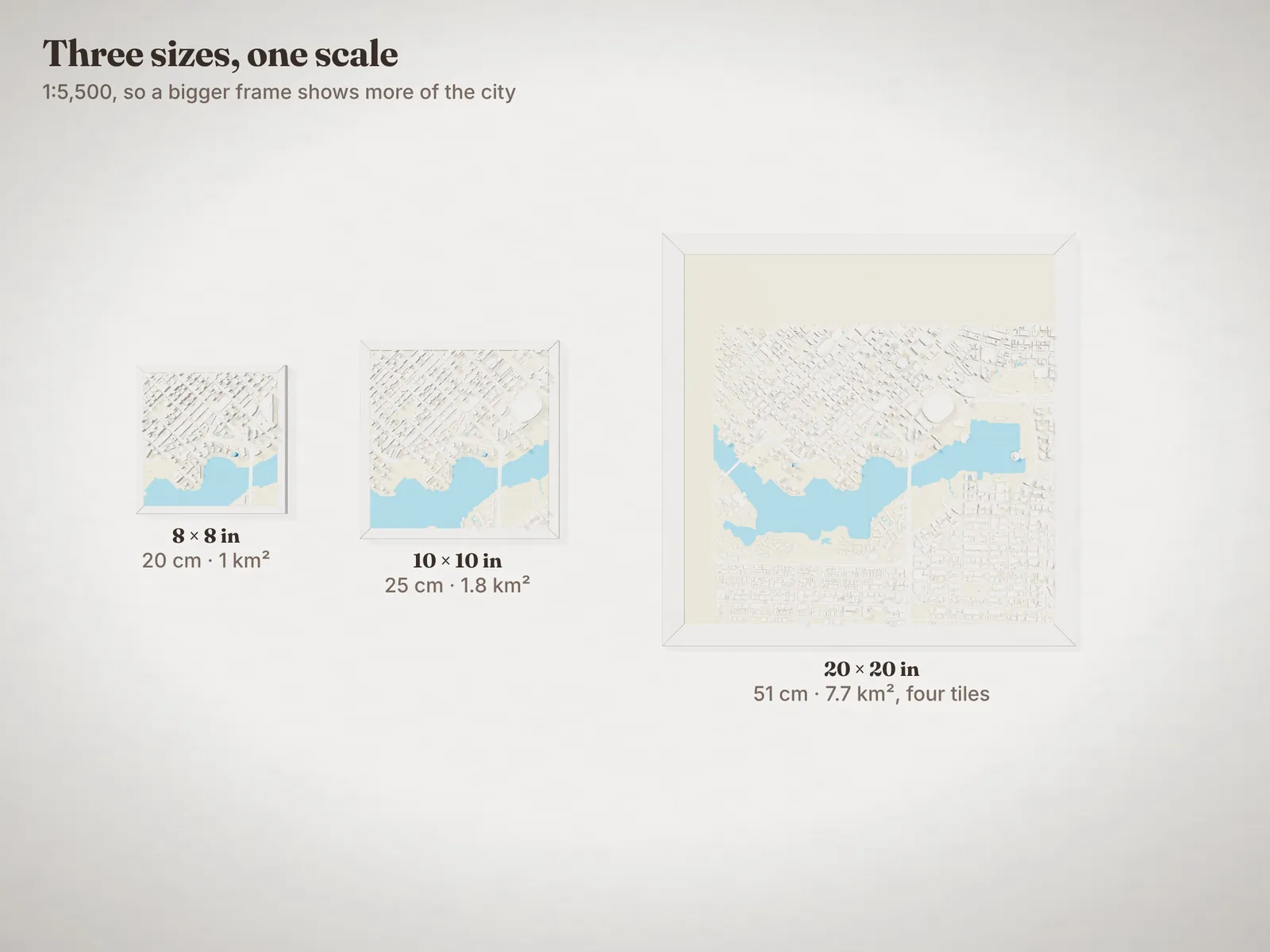
The printer lays down matte, plant-based PLA plastic about a quarter of a millimetre at a time, in up to four colours, from six spools we keep on the shelf: usually one each for the land, the water, the parks and the streets, with the buildings in one of those colours. Pick one of our palettes, or mix your own. Colour changes happen in a band near the base and through the hills, so the buildings rise in one clean colour. There's no rim: at the edges the land is cut clean, so you see its steps stacked like the layers of a hillside. An 8 × 8 in model takes hours; a 20 × 20 in takes days, printed as four tiles and joined in one frame.
The underside is engraved with the place, its coordinates and your order number.
-
We check it against your preview
Every model is checked by hand against the preview you approved before it goes in a frame. Marked buildings are printed in a contrasting colour: terracotta, or sky blue on the Tiny Hometown, Pastel and Mediterranean palettes.
-
It's framed by hand
The model is mounted in a solid wood frame, white or matte black, with hanging hardware fitted. There's no glass: the edge of the model sits level with the front of the frame, and the hills and buildings stand out from it. The engraved plaque goes on the frame if you ordered one.
-
Packed and shipped, tracked
Padded box, a signed certificate card with the place, its coordinates, the map date and your order number, a card crediting the OpenStreetMap volunteers who mapped your streets, your gift note if it's a present, and no prices inside. Your order page, linked from your receipt, shows when it's printing and when it ships, and tracking goes to your email the day it ships.
Why matte plastic
Matte PLA hides the tiny layer lines and lets the shadows between buildings do the work, which is what makes a model look like a model and not a toy. It's made from plants rather than oil. We skip shiny and silk plastics: the shine hides the shapes.
Three sizes, one scale
All three sizes print at the same scale, so a bigger frame shows more of the city rather than bigger buildings. Zoom in up to 2× in the designer to show a smaller area with bigger buildings.
Looking after it
- Dust it with a soft, dry brush.
- Keep it out of direct sun and hot cars: the colours fade over a few years in a sunny south window, and PLA softens in high heat.
- It's decorative, not a toy, and not for children under 3: small parts can break off.
Damaged or faulty? Email a photo within 7 days of delivery and we'll make you a new one, free. See shipping and returns.